Arabic sound practice Arabic tongue twisters · Throat sounds · Heavy S and T
Arabic Tongue Twisters to Hear, Record and Replay
Read these Arabic tongue twisters in Arabic script or the Latin reading, hear each one, then record three takes and replay every throat sound.
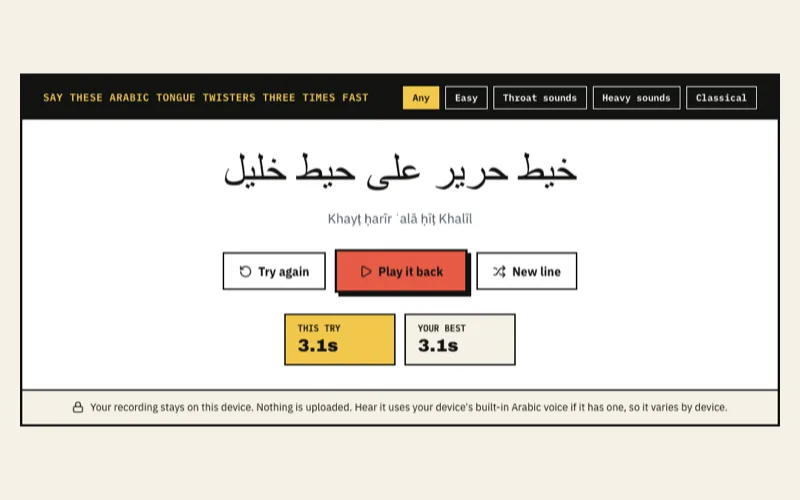
Say these Arabic tongue twisters three times fast
خيط حرير على حيط خليل
Khayṭ ḥarīr ʿalā ḥīṭ Khalīl
This try--
Your best--
Your recording stays on this device. Nothing is uploaded. Hear it uses your device's built-in Arabic voice if it has one, so it varies by device.
What Makes Arabic Tongue Twisters Hard
Arabic speakers often call tongue twisters tamārīn al-lisān (تمارين اللسان), tongue exercises, and children trade the short ones in the schoolyard. Arabic tongue twisters mix Modern Standard Arabic with everyday dialects, so the same line can sound a little different in Cairo, Beirut or Kuwait.
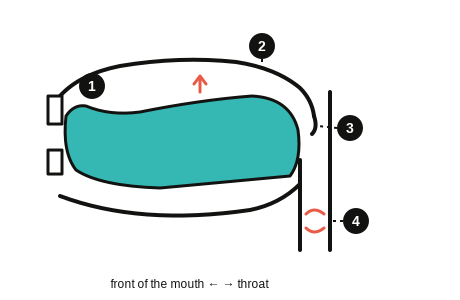
The hard part for English speakers is sounds made deep in the mouth and throat: the breathy Ḥ, the scraped KH, the squeezed ʿayn and the Q at the very back. Arabic tongue twisters also pair a plain S or T with its heavy twin, Ṣ or Ṭ. The diagram shows where those sounds sit, and the table gives one line for each.
1Heavy sounds: tip on the ridge, back of the tongue raisedص Ṣ, ط Ṭ
2Back of the tongue near the soft palate, air scraping throughخ KH
3Back of the tongue against the uvula, a stop deeper than Kق Q
4The throat itself narrows, breathy or squeezedح Ḥ, ع
Five sounds English speakers trip on, with Arabic tongue twisters for each
Arabic sound
Line
Tip
ح Ḥ
لحم الحمام حلال · Laḥm al-ḥamām ḥalāl
Breathe out hard as if fogging a window, with the throat a little tighter than for H.
خ KH
خيط حرير · Khayṭ ḥarīr
The ch in Scottish loch or German Bach: air scraping at the back of the mouth.
ع ʿayn
مفتاح عبد الفتاح · Miftāḥ ʿAbd al-Fattāḥ
Squeeze the throat as if lifting something heavy, then let your voice through.
ق Q
قميص نفيسة نشف · Qamīṣ Nafīsa nishif
Like K, but much further back, where you gargle. Many dialects say it as a catch or a G.
For Ṣ, raise the back of your tongue so the S sounds darker and the vowel after it deepens.
These Arabic tongue twisters are pronunciation practice, not a full Arabic course. Arabic has no P sound, which is why learners going the other way find English P hard.
16 Arabic Tongue Twisters with English Meanings
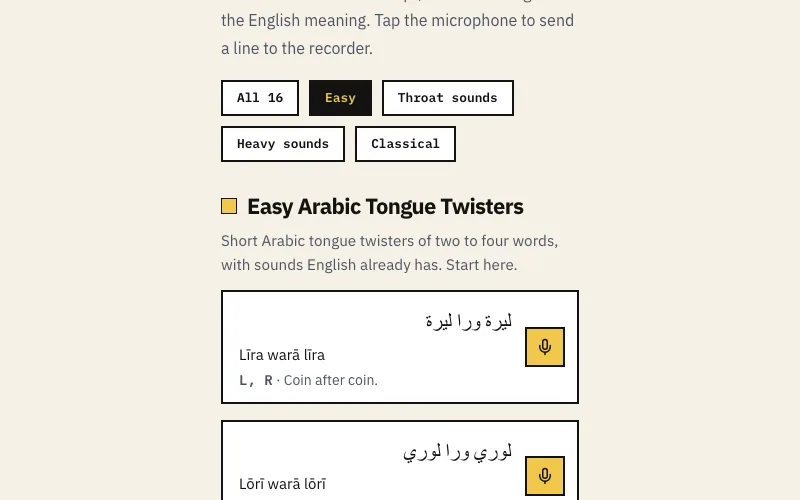
Filter these Arabic tongue twisters by level. Each line shows the Arabic script, a Latin reading and the English meaning. Tap the microphone to send a line to the recorder.
Easy Arabic Tongue Twisters
Short Arabic tongue twisters of two to four words, with sounds English already has. Start here.
ليرة ورا ليرة
Līra warā līra
L, R · Coin after coin.
لوري ورا لوري
Lōrī warā lōrī
L, R · A lorry after a lorry.
شمس مشمسة
Shams mushmisa
SH, S, M · A sunny sun.
شرشف شريف
Sharshaf Sharīf
SH, R, F · Sharif's bedsheet.
Arabic Tongue Twisters with Throat Sounds
These Arabic tongue twisters stack Ḥ, KH and ʿayn. Keep each one in the throat instead of turning it into an English H or K.
K, L, ʿ, wordplay · I knocked on the door until my hand hurt. She said, Ismail, be patient. I said, Asma, my patience has run out.
How to Practice Arabic Tongue Twisters
The best Arabic tongue twisters for you are the ones you can say cleanly. Work through Arabic tongue twisters in this order.
1
Read the Latin line first
Before speed, read the Latin reading of the Arabic tongue twisters slowly. Long vowels with a line on top, like ā, are held twice as long.
2
Hear it
Press Hear it to hear the Arabic tongue twisters in your device's Arabic voice, then say each line once, slowly, while you look at the Arabic script.
3
Record and listen
Record three quick takes of the Arabic tongue twisters and replay them. Mark the word where Ḥ turned into H or Q turned into K.
4
Speed up on clean takes only
Go faster only after a clean take. Your best time updates on this device when you beat it.
Five minutes of Arabic tongue twisters a day, one group at a time, does more than an hour once a week.
How We Picked and Tested These Arabic Tongue Twisters
Sources
All 16 Arabic tongue twisters here are traditional lines that circulate among Arabic speakers. We checked the Arabic script against at least one published list, and the silk thread, Khamis and apricot lines against two or more. The duck line appears only in Latin letters, so the Arabic spelling there is ours.
Readings
The Latin reading gives you the Arabic tongue twisters in English letters, with one system for every line: a line over a long vowel, a dot under heavy letters, and ʿ for ʿayn. Dialect lines are tagged where the sound changes, such as Egyptian or Kuwaiti.
Recorder
We tried record, stop, replay and the best time with Arabic tongue twisters in desktop Chrome and at phone width, with the Arabic script shown right to left. Hear it appears only when your device has an Arabic voice. Nothing leaves your device.
Limits
These Arabic tongue twisters have not been read through line by line by a native-speaker teacher, and the recorder does not score your Arabic. Use the playback with Hear it, a teacher or a friend.
Arabic tongue twisters work for a class warm up, a language exchange, or friends who grew up with them.
2+ players
Khamis relay
Pass the Khamis and Habash line around the circle. Whoever swaps the two names starts the next round.
2+ players
Beat the clock
Everyone records the same one of these Arabic tongue twisters. The fastest clean take wins.
3+ players
Teach me one
A native speaker says one of their own Arabic tongue twisters. The others try it, and the speaker picks the best take.
When Arabic tongue twisters feel easy, try Russian tongue twisters for another script, hard tongue twisters in English, tongue twisters with P for the sound Arabic does not have, or voice a real movie scene.
Many Arabic speakers name the line about Harb's grave, wa-qabru Ḥarbin qafrun. It is an old line of verse that Arabic writers have quoted for over a thousand years as nearly impossible to say fast, because Q, B and R keep colliding.
What is the most famous Arabic tongue twister?
Khayṭ ḥarīr ʿalā ḥīṭ Khalīl, a silk thread on Khalil's wall, is the one most Arabic speakers know. It drills KH and Ḥ in six words.
What are tongue twisters called in Arabic?
Tongue twisters in Arabic are often called tamārīn al-lisān, written تمارين اللسان, which means tongue exercises. Many people simply call them sentences that are hard to say fast.
Are there Arabic tongue twisters with harakat?
Most lines here are shown the way people usually write them, without full harakat, the small vowel marks. The Latin reading under each line gives every vowel, and the classical lines keep the marks they have in their published form.
Are there tongue twisters in other languages here?
Yes. Besides Arabic tongue twisters, there are Polish tongue twisters and pages in Russian, German, French, Spanish, Chinese, Japanese and Korean.
Is my recording saved anywhere?
No. The recording stays in your browser on this device, and nothing is uploaded.
Ready to Voice a Whole Scene?
Arabic tongue twisters train sounds deep in your throat. Our dubbing game puts your voice on a movie or cartoon scene you can watch back.