Sources
All 20 Japanese tongue twisters here are traditional hayakuchi kotoba in their common public form, from children's rhymes to announcer drills. We left out new ones made for TV shows.
Hear these Japanese tongue twisters, follow the romaji, say each one three times, then play your take back and count the beats.
Say these Japanese tongue twisters three times fast
生麦生米生卵
Nama mugi, nama gome, nama tamago.
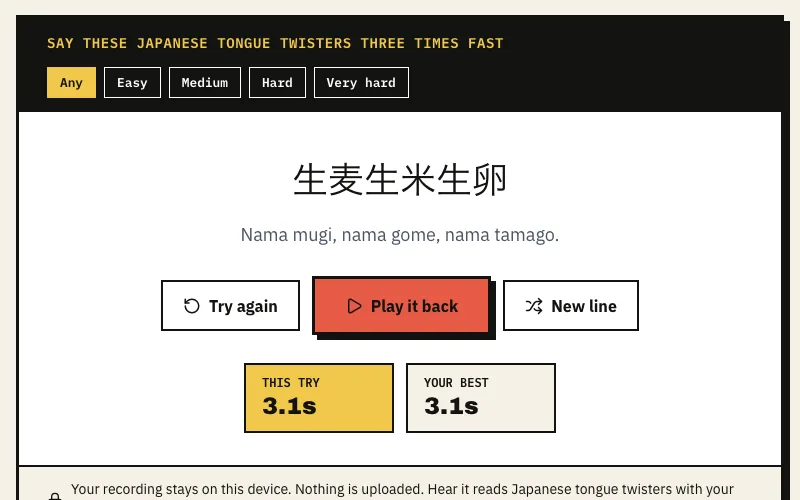
Your recording stays on this device. Nothing is uploaded. Hear it reads Japanese tongue twisters with your device's Japanese voice, if it has one.
In Japan a tongue twister is a hayakuchi kotoba (早口言葉), literally fast mouth words. TV hosts and voice actors warm up with Japanese tongue twisters before they go on air.
Japanese runs on even beats called mora. Every kana gets one beat, and so do a long vowel, the small tsu pause and the final n. English speakers rush those beats, so Tōkyō comes out as Tokyo. The chart counts the beats in one famous line; the table pairs each tricky sound with a line.
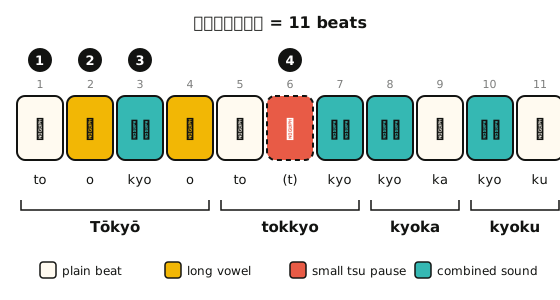
Five sounds English speakers trip on, with Japanese tongue twisters for each
| Japanese sound | Line | Tip |
|---|---|---|
| Long vowels | 坊主が屏風に Bōzu ga byōbu ni | Hold ō for two beats. A short o throws off the rhythm of the whole line. |
| Small tsu pause | 東京特許 Tōkyō tokkyo | Stop the air for one beat before the K, as in book case. |
| KY, PY and other combined sounds | 蛙ぴょこぴょこ Kaeru pyoko pyoko | Say pyo in one quick move, not pee-yo. |
| The R tap | 瓜売り Uriuri | Tap the tongue once behind the top teeth, close to the tt in butter. |
| TSU and SH | 除雪車 Josetsusha | TSU starts with a T and ends in a hiss, like the end of cats. |
These hayakuchi kotoba are pronunciation practice, not a full Japanese course.
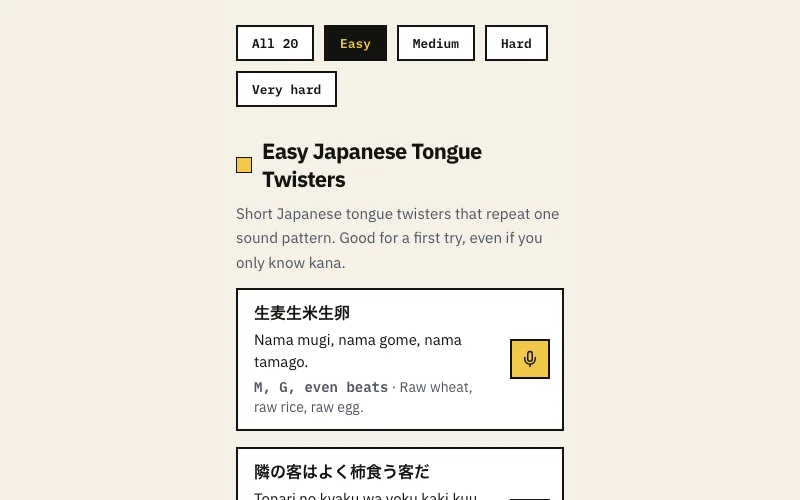
Filter these Japanese tongue twisters by level. Each line has romaji and an English meaning; the microphone sends it to the recorder.
Short Japanese tongue twisters that repeat one sound pattern. Good for a first try, even if you only know kana.
生麦生米生卵
Nama mugi, nama gome, nama tamago.
M, G, even beats · Raw wheat, raw rice, raw egg.
隣の客はよく柿食う客だ
Tonari no kyaku wa yoku kaki kuu kyaku da.
K vs KY · The guest next door is a guest who eats a lot of persimmons.
すもももももももものうち
Sumomo mo momo mo momo no uchi.
M, O · Plums and peaches are both part of the peach family.
バスガス爆発
Basu gasu bakuhatsu.
B, G, TSU · A bus gas explosion.
裏庭には二羽、庭には二羽鶏がいる
Uraniwa ni wa niwa, niwa ni wa niwa niwatori ga iru.
N, W, R · Two chickens in the back yard, two chickens in the front yard.
The Japanese tongue twisters most people in Japan learned as kids, with long vowels and combined sounds.
赤巻紙青巻紙黄巻紙
Aka makigami, ao makigami, ki makigami.
K, M, vowel runs · Red rolled paper, blue rolled paper, yellow rolled paper.
赤パジャマ黄パジャマ茶パジャマ
Aka pajama, ki pajama, cha pajama.
J vs CH · Red pajamas, yellow pajamas, brown pajamas.
坊主が屏風に上手に坊主の絵を描いた
Bōzu ga byōbu ni jōzu ni bōzu no e o kaita.
Long vowels, BY, J · A monk skillfully drew a picture of a monk on a folding screen.
蛙ぴょこぴょこ三ぴょこぴょこ、合わせてぴょこぴょこ六ぴょこぴょこ
Kaeru pyoko pyoko mi pyoko pyoko, awasete pyoko pyoko mu pyoko pyoko.
PY · Frogs hop hop, three hop hops; all together, six hop hops.
東京特許許可局
Tōkyō tokkyo kyoka kyoku.
KY, small tsu, long vowels · The Tokyo Patent Approval Office, an office that does not exist.
老若男女
Rōnyaku nannyo.
NY, R, N · Men and women, young and old.
Longer Japanese tongue twisters that switch between close sounds like S and SH, or J and ZY.
新進シャンソン歌手総出演新春シャンソンショー
Shinshin shanson kashu sō shutsuen shinshun shanson shō.
S vs SH, final N · A New Year chanson show with every rising chanson singer on stage.
除雪車除雪作業中
Josetsusha josetsu sagyōchū.
J, TSU, SH · Snowplow at work, clearing snow.
魔術師魔術修行中
Majutsushi majutsu shugyōchū.
J, TSU, SHU · A magician in magic training.
打者走者勝者走者一掃
Dasha sōsha shōsha sōsha issō.
SH vs S, long vowels · Batter, runner, winner: the hit clears every runner.
お綾や親にお謝り
Oaya ya, oya ni oayamari.
Vowel runs, Y · Aya, go and apologize to your parents.
The longest Japanese tongue twisters here. Announcers in Japan practice these too.
この竹垣に竹立てかけたのは竹立てかけたかったから竹立てかけた
Kono takegaki ni take tatekaketa no wa, take tatekaketakatta kara, take tatekaketa.
T, K · I leaned bamboo on this bamboo fence because I wanted to lean bamboo on it.
瓜売りが瓜売りに来て瓜売り残し売り売り帰る瓜売りの声
Uriuri ga uri uri ni kite, uri uri nokoshi, uri uri kaeru uriuri no koe.
R tap, vowels · A melon seller came to sell melons, had some left, and went home still calling out.
抜きにくい釘、引き抜きにくい釘、釘抜きで抜く釘
Nukinikui kugi, hikinukinikui kugi, kuginuki de nuku kugi.
N, K · A nail hard to pull, a nail hard to pull out, a nail you pull with a nail puller.
東京特許許可局局長今日急遽休暇許可拒否
Tōkyō tokkyo kyoka kyoku kyokuchō, kyō kyūkyo kyūka kyoka kyohi.
KY, long vowels · The director of the Tokyo Patent Approval Office suddenly refused leave today.
Beats first, speed last. Japanese tongue twisters only help when every beat is still there.
Press Hear it twice and follow the romaji. A line over a vowel, as in ō, means hold it for two beats.
Say the line slowly and clap once per kana. Tōkyō gets four claps, not two.
Record one of these Japanese tongue twisters and play it next to the device voice. Listen for a dropped long vowel or pause.
Go faster only when every beat survives. Your best time updates on this device.
Two Japanese tongue twisters a day, five clean takes each, beats one long weekly session.
All 20 Japanese tongue twisters here are traditional hayakuchi kotoba in their common public form, from children's rhymes to announcer drills. We left out new ones made for TV shows.
The Japanese tongue twisters romaji on this page is Hepburn, with a line over long vowels (ō, ū) and a double letter for the small tsu (tokkyo). The particles は and を are written wa and o, the way they sound.
We tried record, stop, replay and the best time in desktop Chrome and at phone width. Long lines in Japanese script shrink to fit the recorder.
The recorder does not grade Japanese tongue twisters or pitch accent. Hear it works only if your device has a Japanese voice. You judge the playback.
Background on how Japanese counts beats: Wikipedia, Japanese phonology: mora.
Updated November 18, 2026
Japanese tongue twisters work as a class warm up or a party round, even for beginners.
Take turns on Nama mugi. Say it three times; drop a beat and the next player goes.
Everyone records the Tokyo patent office line. The fastest take with all 11 beats wins.
One player says one of the Japanese tongue twisters. The others guess what it means before the reveal.
Once Japanese tongue twisters feel easier, try Chinese ones with tones, or put your voice on an anime scene.
Tongue twisters in Japanese are called hayakuchi kotoba, written 早口言葉. It means fast mouth words, and it is the word you would search in Japan.
Nama mugi, nama gome, nama tamago (raw wheat, raw rice, raw egg) is the Japanese tongue twister almost everyone in Japan knows. Tonari no kyaku, about the persimmon eating guest, is a close second.
Many people pick the long Tokyo patent office line, because it stacks KY sounds, long vowels and small tsu pauses. On this page it sits in the Very hard group.
Yes. Every line here has romaji. Start with Sumomo mo momo mo, which uses only M and O, then Basu gasu bakuhatsu.
Yes. Voice actors in Japan drill Japanese tongue twisters to keep fast lines clear. Our anime voice acting scripts let you try the next step.
No. The recording stays in your browser on this device, and nothing is uploaded.
Japanese tongue twisters warm up your mouth. Our dubbing game puts your voice on a movie or anime scene you can watch back.
Play the dubbing game